
Fear Free Veterinary Care in Colorado Springs: What It Actually Means, and Why It Matters for Every Pet
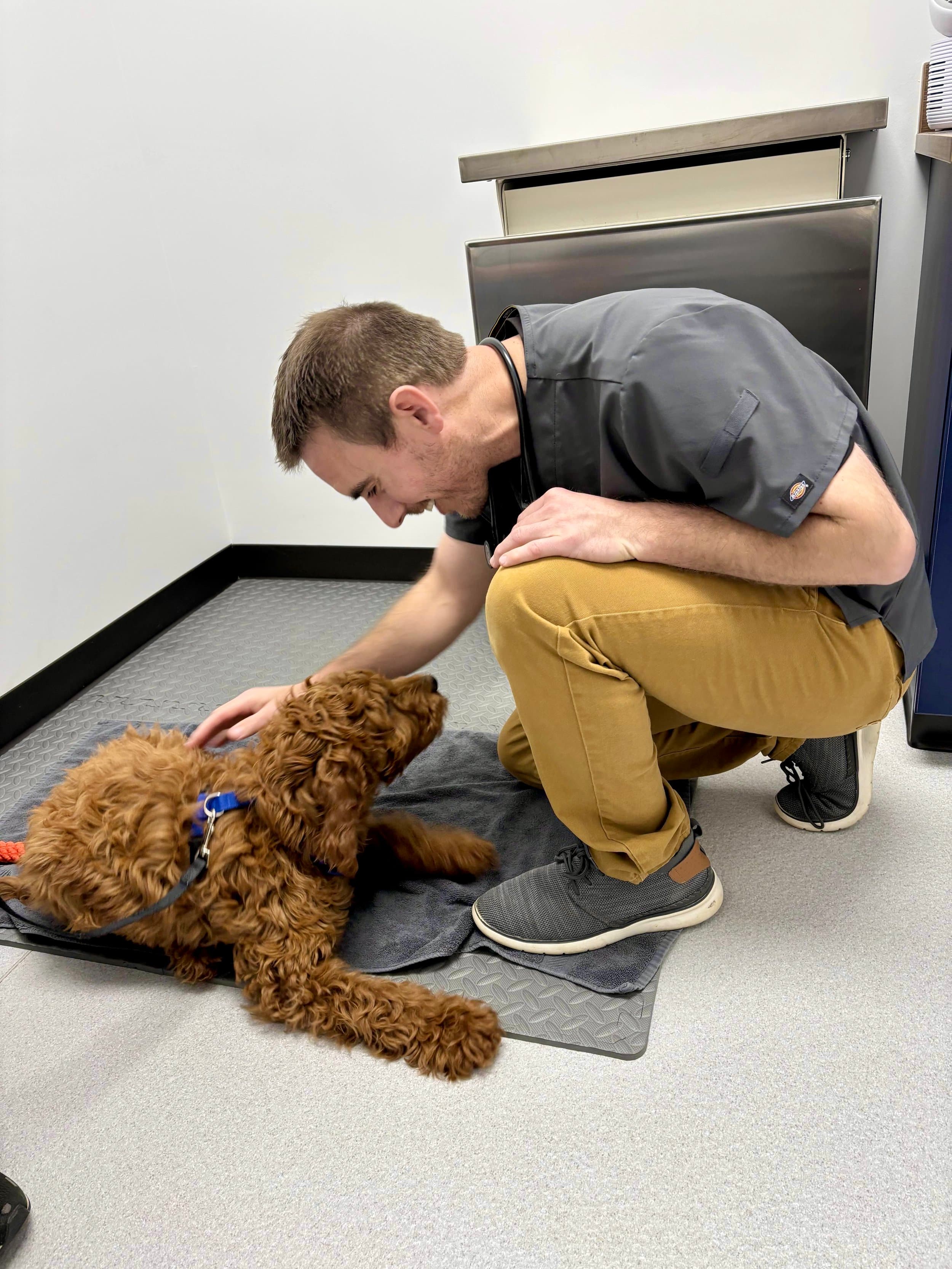
Quick take
- Fear Free is a real veterinary certification, not a marketing label. Every Red Rock team member holds an individual Fear Free certification.
- A calm pet gets better medicine. Stress distorts heart rate, blood pressure, bloodwork values, and orthopedic findings.
- Fear Free is not just for anxious pets. It also keeps easygoing pets easygoing and is especially important for seniors.
- If your pet has had a difficult vet experience before, please tell us at booking. We will plan around it.
Fear Free veterinary care is a clinical method, not a marketing slogan. It is a certification program founded by veterinarian Dr. Marty Becker that trains practices to recognize, prevent, and treat fear, anxiety, and stress (FAS) in pets during medical visits. At Red Rock Veterinary Health in Colorado Springs, every member of our team is Fear Free certified, our facility was designed from the ground up around Fear Free principles, and our entire visit workflow, from the parking lot to checkout, is built to keep your pet's stress level low. That last part matters more than most pet owners realize, because a calm pet gets more accurate medicine.
I am Dr. Unsell. Along with Dr. Muelhaupt and Dr. Clevenger, I see patients on the Westside of Colorado Springs, in a hospital that Dr. Kuca designed and manages around Fear Free principles. In this guide I want to explain what Fear Free actually involves, why our hospital looks and feels different from a traditional vet clinic, and why this approach benefits every pet, not just the anxious ones.
What Fear Free really means
A Fear Free clinic does three things differently from a conventional veterinary practice.
1. Every team member is trained to read pet body language
The Fear Free certification program covers feline and canine behavior, low-stress restraint, pheromone use, pre-visit anti-anxiety medication protocols, and species-appropriate handling for everything from a Yorkie's nail trim to a senior cat's bloodwork. Every veterinarian, technician, and front desk team member at Red Rock holds an individual Fear Free certification, and we re-certify annually.
2. The physical environment is designed to reduce sensory overload
That includes fully separate waiting rooms, exam rooms, and treatment areas for cats and dogs so cats do not see, hear, or smell dogs, soft surfaces, quieter equipment, pheromone diffusers (Feliway for cats, Adaptil for dogs), non-slip exam room flooring, dim lighting in cat areas, and the option to skip the exam table entirely if your pet is more comfortable on the floor or in your lap.
3. The visit protocol prioritizes emotional safety alongside medical findings
We assess and note FAS (fear, anxiety, stress) on every visit using the Fear Free framework, which maps observed behaviors to green, yellow, and red zones on a 0-to-5 scale. If a pet moves into the yellow or red zone during a procedure, we pause, give the pet a break, reassess, and sometimes reschedule with pre-visit anti-anxiety medication onboard. Every exam room is stocked with high-value rewards (treats, peanut butter, churu) so we always have something to redirect attention with.
Key Takeaway
Fear Free is auditable training, environmental design, and a visit protocol, not staff personality. It is something a clinic does, not something it is.
Why a calm pet gets better medicine
Stress is not just an emotional problem. It is a clinical problem. Here is what fear and anxiety do to the exam itself:
- Heart rate and blood pressure are inflated by stress, so vital signs taken from a panicked dog do not reflect true baseline cardiac health. We can miss early cardiovascular disease, or chase a phantom problem that disappears at home.
- Bloodwork values shift. Stress hyperglycemia is well documented in cats; a cat that arrived terrified can show artificially high blood glucose, which can be misread as early diabetes.
- Subtle lameness disappears when a dog is too frightened to walk normally. Orthopedic exams are unreliable in a shut-down patient.
- Stress hormones can interfere with post-procedure recovery, including wound healing, which means a calm patient often recovers more smoothly from surgery, dental work, or biopsies.
- Owners get worse information. A pet that hides every symptom at the clinic gives us very little to work with diagnostically. That can lead to extra tests, missed conditions, or repeat visits.
This is why Fear Free is a medical standard, not a comfort upgrade. There is also a direct anesthesia connection: a pet with a lower baseline catecholamine load at induction typically requires a lower induction dose and has a smoother anesthetic course. Lower stress means more accurate exams, safer anesthesia, and better long-term outcomes.
Colorado Springs-specific stressors worth knowing about
Two factors uniquely affect pets seen on the Front Range. Both are worth keeping in mind before any vet visit.
- Non-acclimated visiting pets. A dog or cat brought up from sea level to Colorado Springs (around 6,035 feet at the Westside) will breathe harder for the first one to three days while their body adapts to the lower partial pressure of oxygen. That increased respiratory effort can be misread as distress, especially layered on top of vet-visit anxiety. If your visiting family member's pet is coming in soon after arrival, tell us at booking.
- Intense UV and rapid car-cabin heat at altitude. A car that feels mild outside can climb into dangerous temperatures within minutes in our sun. Never leave a pet in the car pre-visit, even briefly. If you arrive early, text us and we will bring you straight back to a room.
What walking into Red Rock actually looks like
We get asked all the time whether Red Rock's Fear Free environment is really different, or whether it's a label that more clinics could claim. Here is what is concrete:
- No lobby waiting. When you arrive, you can text us from your car and go directly to your exam room when it's ready. Most anxious pets never see the waiting area.
- Separate spaces for cats and dogs. We have one shared entrance, but fully separate waiting rooms, exam rooms, and treatment areas for dogs and cats, so cats do not see, hear, or smell dogs during a typical visit. We are the only hospital in Colorado Springs that separates the waiting, exam, and treatment areas this way.
- In-room procedures whenever possible. Bloodwork, vaccines, nail trims, and most minor diagnostics happen in the exam room you and your pet are already in. We do not whisk pets away to a back room unless it is medically necessary.
- Treats, distractions, and floor exams. Every exam room is stocked with high-value rewards. If your dog will not tolerate a table, we examine on the floor. If your cat does best in the carrier, we examine in the carrier.
- Pre-visit calming medications when appropriate. For pets with known FAS, we send home pre-visit medication a few hours before the appointment, chosen for your pet from options like gabapentin, trazodone, clonidine, acepromazine, and dexmedetomidine. We also recommend nutraceuticals and calming aids such as pheromones, CBD, and milk-protein supplements. Most take the edge off so your pet can think clearly and tolerate the exam, rather than heavily sedating them.
- Happy visits and victory visits. We encourage short, no-procedure trips where your pet comes in just for treats and to meet the team, then leaves. Happy visits build positive associations from the start; victory visits rebuild them after a hard experience. Both are always free, and over time they change how your pet feels about the building.
- A pause protocol. If a pet enters the yellow or red FAS zone during a procedure, we stop. We do not push through.
Key Takeaway
These are not amenities. They are clinical workflow decisions designed to make medicine work better for fearful patients. Every member of the Red Rock team is trained and certified to do them, every visit.
Fear Free is not just for anxious pets
The most common misconception we hear is, 'My pet is easygoing, so we don't need Fear Free.' But the calm pet who tolerates a rough handling session today is the same pet who gets a little more reluctant next time, then resistant the time after that. Most behavioral problems at the vet are made, not born. By using low-stress handling on every patient from day one, we keep easygoing pets easygoing, and we prevent the steady erosion of trust that turns puppies into hard-to-handle adults.
For senior pets, Fear Free becomes especially important. Older animals have more sensory deficits, more pain, and less tolerance for restraint. A standard vet visit can be physically painful for an arthritic dog or a cat with hypertension. Our slower, gentler workflow is not a luxury for these patients, it is medically necessary.
If your pet has had a bad experience before, tell us at booking
When you book a first visit, we ask about your pet's history, including any prior bad veterinary experiences, known triggers, and behavior at home. Based on that intake, we decide together whether your pet would benefit from pre-visit anti-anxiety medication, a happy visit before the real exam, or a modified exam plan. None of this costs extra, it is part of how we practice medicine.
If you are switching from another vet because your pet had a bad experience, please tell us. About 1 in 4 of our new clients come to us after a difficult experience at a previous vet, and we structure their first few visits specifically to repair that association. The first appointment may run a little longer than a routine exam because we are not just doing medicine, we are rebuilding trust.
Frequently Asked Questions
What is Fear Free veterinary care?+
Fear Free is a certification program for veterinary practices that trains every team member to recognize and reduce fear, anxiety, and stress in pets during medical visits. It combines behavioral training, environmental design, and modified clinical workflows. At Red Rock Veterinary Health in Colorado Springs, every veterinarian, technician, and front desk team member is individually Fear Free certified.
Is Red Rock the only Fear Free certified vet in Colorado Springs?+
No, and we want to be accurate about that: Colorado Springs has more than one Fear Free certified hospital. What sets Red Rock apart is that we are the only veterinary hospital in Colorado Springs that was designed from the ground up, in both physical layout and visit workflow, around Fear Free principles, and the only Fear Free hospital on the Westside. Every member of our clinical team also holds an individual Fear Free certification.
Does Fear Free care cost more?+
Our standard exam fee is $79, with a same-day (urgent) exam at $109, in line with other independent veterinary hospitals on the Colorado Springs Westside. What you are paying for is a longer visit, a calmer pet, more accurate diagnostics, and fewer repeat visits. We do not charge extra for Fear Free protocols, it is how every appointment is run.
Will my pet need sedation for every visit?+
No. Most pets do not need any medication. For pets with documented fear, anxiety, or stress, we send home pre-visit medication a few hours before the appointment, chosen for your pet from options like gabapentin, trazodone, clonidine, acepromazine, and dexmedetomidine. We also recommend calming nutraceuticals such as pheromones, CBD, and milk-protein supplements. Most of these take the edge off so your pet can think clearly and tolerate the exam, rather than heavily sedating them.
My dog hates muzzles. Can you still examine him?+
Yes. We rarely use muzzles. We use treats, distraction, slow handling, and positional adjustments instead. If a pet's stress level rises during a procedure, we stop and try a different approach. For pets that genuinely need restraint for safety, we use the least restrictive option that works, and we always discuss it with you first.
My cat is terrified of the carrier. Is there anything I can do before the visit?+
Yes, and we can coach you through it. Leave the carrier out at home with a familiar blanket inside, spray it with Feliway 15 minutes before transport, and treat the drive itself as a separate desensitization project. We can also schedule a happy visit, a short no-procedure trip just for treats, so your cat associates Red Rock with something positive before any medical work happens.
Do you offer separate waiting areas for cats and dogs?+
Yes. We have one shared entrance, but fully separate waiting rooms, exam rooms, and treatment areas for cats and dogs, so cats do not see, hear, or smell dogs during a typical visit. We are the only hospital in Colorado Springs that separates the waiting, exam, and treatment areas this way. We also encourage car waiting, you can text us when you arrive and go directly to your exam room.
I had a bad experience at another Colorado Springs vet. Will it be different here?+
It should be. About 1 in 4 of our new patients are switching from another clinic because of a difficult experience. Our intake process explicitly asks about prior bad-vet history, and we structure the first few visits to repair that association. The first appointment may run a little longer than a routine exam because we are not just doing medicine, we are rebuilding trust.
Tags
Ready to Experience Exceptional Veterinary Care?
Contact Red Rock Veterinary Health today to schedule an appointment or learn more about our comprehensive pet care services.